






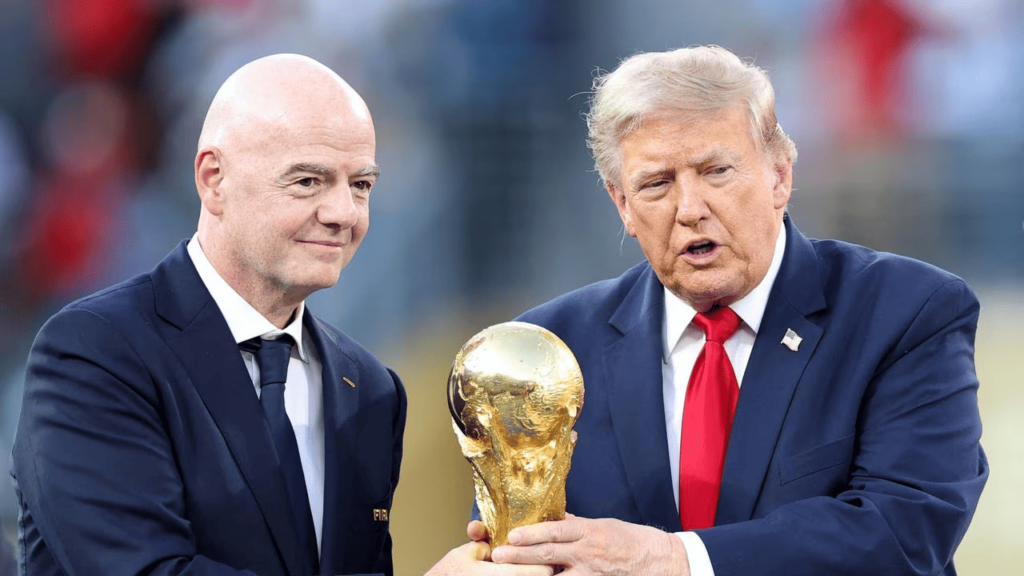
Opponents of FIFA president Gianni Infantino are considering a campaign of non cooperation with world football’s governing body unless he leaves his position, according to senior sources within UEFA.
Figures involved in the growing rebellion have reportedly insisted that they will not reverse their stance while Infantino remains in charge. The dispute has intensified following the collapse of his proposal to allow private investors to purchase stakes connected to FIFA’s leading competitions.
The exact form of the possible disruption has not yet been established. However, one senior official said they expected some federations and representatives to refuse to attend FIFA meetings.
Pressure on Infantino has increased after UEFA warned that it could take legal action over the investment proposal. Wales has also formally withdrawn its support for his attempt to secure a fourth term as FIFA president, while the English Football Association is expected to make the same decision.
Infantino faces a difficult re election campaign
Infantino is due to seek re election in March for what would be his final term as president. To remain in office, he would need at least 106 votes from FIFA’s 211 member associations.
Sources have told BBC Sport that the Scottish Football Association shares UEFA’s lack of confidence in the 56 year old president.
His leadership had already faced public criticism from governing bodies in Europe, North America, Central America and the Caribbean. Both UEFA and Concacaf issued statements questioning the plan to involve private investors in FIFA competitions.
Serbia, Sweden and Finland have joined Wales in withdrawing their support for Infantino. England is also preparing to confirm that it will no longer endorse his candidacy.
However, Infantino continues to receive backing from several associations. Morocco, Qatar, Lebanon, Kuwait and Sri Lanka are among the countries that have publicly supported his continued leadership.
The distribution of votes across FIFA’s confederations could play a decisive role. UEFA has 55 members, the Confederation of African Football has 54, the Asian Football Confederation has 46 and Concacaf controls 35 votes. Oceania has 11 members, while Conmebol has 10.
The Asian Football Confederation has said it stands in solidarity with UEFA and Concacaf. Africa, Conmebol and Oceania have not publicly criticised Infantino’s proposal.
FIFA Council could call an emergency meeting
Infantino could also face pressure from within the FIFA Council, which has the authority to convene an emergency meeting.
Such a meeting would have to be arranged if at least 19 of the council’s 37 members requested it. Once triggered, the session would need to take place within two weeks.
UEFA has nine representatives on the FIFA Council. The Asian confederation has seven, Africa has six, Concacaf and Conmebol each have five, while Oceania has three.
The council also includes Infantino and FIFA secretary general Mattias Grafstrom.
If enough members from different confederations join the opposition, the council could attempt to push Infantino towards resignation before the presidential election.
European support alone may not be enough to remove him. His opponents would therefore need backing from officials in Asia, Africa, North America, Central America, the Caribbean, South America or Oceania.
Investment plan caused the latest crisis
The dispute centres on FIFA Forward Enterprise, known as FFE, a proposed commercial subsidiary that would have managed FIFA’s principal events, including the men’s and women’s World Cups.
Under the plan, outside investors would have been permitted to buy minority stakes in the new company. FIFA said those investments would not have given third parties control over the subsidiary.
Thrive Eternal was expected to lead the group of potential investors. Thrive is an American venture capital company founded by Joshua Kushner, the brother of Jared Kushner, who is married to the daughter of United States President Donald Trump.
The proposal met strong resistance from UEFA and Concacaf. Critics raised concerns about governance, decision making and the possible consequences of allowing private investors to hold financial interests in FIFA’s main tournaments.
FIFA eventually abandoned the scheme, but the decision did not end the dispute. Opponents have continued to question how the proposal was developed, approved and presented to member associations.
UEFA considers legal and regulatory action
UEFA warned Infantino in a formal letter that it was considering legal proceedings, arbitration and regulatory complaints connected to the FFE project.
European football’s governing body also demanded that FIFA immediately preserve all documents and electronically stored information relating to the proposal.
UEFA said the records must be protected regardless of any internal FIFA policies that might allow routine deletion or destruction of materials.
The request covered emails, text messages, written correspondence, meeting notes and communications sent through platforms such as WhatsApp, Signal, Microsoft Teams and Slack.
UEFA also requested records involving FIFA officials, employees, committee members, advisers and agents. Its demand extended to communications with member associations, confederations, sponsors, broadcasters, banks and other financial organisations.
Infantino was asked to confirm in writing within five business days that he had received the notice, understood its requirements and had acted to preserve the relevant information.
BBC Sport contacted FIFA for a response to the claims and the possible non cooperation campaign.
Payments to associations receive further scrutiny
Infantino had written to all 211 FIFA member associations offering each of them $40 million if they supported the investment project.
The associations were given a deadline of 19 September to qualify for an initial payment of $20 million.
UEFA requested that FIFA retain all documents relating to this proposed payment structure. It specifically asked for records showing how the payments were designed, modelled, legally justified, approved and communicated to national associations.
The financial offer has become a central part of the dispute, with critics questioning the connection between the proposed payments and support for the FFE project.
The controversy has placed further pressure on FIFA’s governance procedures and on Infantino’s personal handling of the plan.
McAllister calls for leadership change
UEFA vice president Laura McAllister described the prospect of legal action as a direct response to what she regarded as a deeply flawed governance process.
Speaking to BBC Radio 5 Live, the former Wales international said football’s governing bodies needed to examine how the FFE initiative had reached such an advanced stage.
She argued that stronger accountability procedures were required to prevent similar situations from happening again.
McAllister has played a prominent role in the opposition to Infantino and hopes more national associations will withdraw their support before the election.
She described the current dispute as a major moment for international football and said governing bodies could not continue responding to plans developed without sufficient consultation.
McAllister also expressed hope that FIFA would have new leadership next year.
With more European associations reconsidering their positions and the possibility of non cooperation being discussed, Infantino now faces one of the most serious challenges of his presidency.