






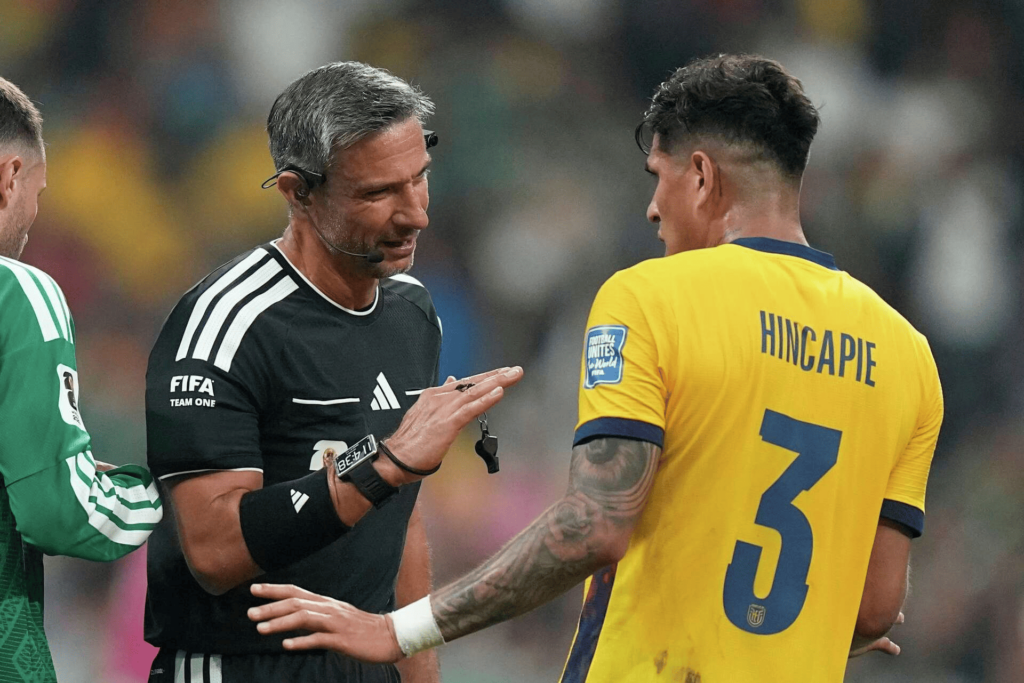
Ecuador defender Piero Hincapie became the second player at the 2026 World Cup to receive a red card for covering his mouth while confronting an opponent.
The Arsenal centre back was dismissed during Ecuador’s 2-0 defeat by Mexico on Tuesday evening, a result that ended his team’s tournament. The incident happened in stoppage time at the end of the second half, with Ecuador already heading out of the competition.
Hincapie, 24, covered his mouth while speaking to Mexico forward Santiago Gimenez. Slovenian referee Slavko Vincic did not spot the moment live, but the video assistant referee advised him to review it on the pitchside monitor.
After checking the replay, Vincic showed Hincapie a red card.
FIFA rule catches another player
Hincapie is not the first player to be punished under FIFA’s new tournament rule.
Paraguay winger Miguel Almiron was sent off earlier in the World Cup for a similar offence during a group stage match against Turkey. Paraguay still managed to protect their lead and win 1-0, despite finishing the match with 10 players.
The rule has already created debate because not every case of mouth covering has led to a dismissal. Last week, England midfielder Jude Bellingham was not sent off after covering his mouth while speaking to Ghana forward Jordan Ayew.
Before the tournament, FIFA referees chief Pierluigi Collina explained that players are still allowed to cover their mouth during friendly conversations. The rule is aimed at confrontational exchanges rather than ordinary communication between players.
Why the rule was introduced
The decision to bring in the rule was made during a special meeting of the International Football Association Board in Vancouver in April.
FIFA president Gianni Infantino had already spoken in favour of stronger punishment for this type of action. He said referees should begin from the assumption that a player covering his mouth during a confrontation may have said something he should not have said.
The issue became a wider talking point in February after Benfica winger Gianluca Prestianni raised his shirt while speaking to Real Madrid forward Vinicius Jr during a Champions League match.
Prestianni was accused of racist abuse, which he denied, and was provisionally banned for one match. After a UEFA investigation, he was instead found guilty of homophobic conduct and received a six match suspension, with three matches suspended.
Final decision still belongs to the referee
Even with the rule in place, a red card is not automatic in every situation.
The referee must still judge the full context before making a final decision. That includes the nature of the exchange, the behaviour of the players and whether the incident is considered confrontational.
In Hincapie’s case, the VAR review convinced Vincic that the action met the threshold for a sending off. It added another painful moment to Ecuador’s exit and gave the 2026 World Cup another major talking point around a rule that is still being tested in real match situations.